Case Study · AP Environmental Science
Deconstructing APES Study Lab
A study loop for AP Environmental Science: find a baseline, separate concept gaps from math and task-word gaps, then refine and practice under exam conditions.
The Insight
Knowing a question was wrong is not the same as knowing what to practice next. APES Study Lab organizes a miss by the concept, calculation, or task word involved, then connects it to a focused drill and a retest.
The Interface (Annotated)
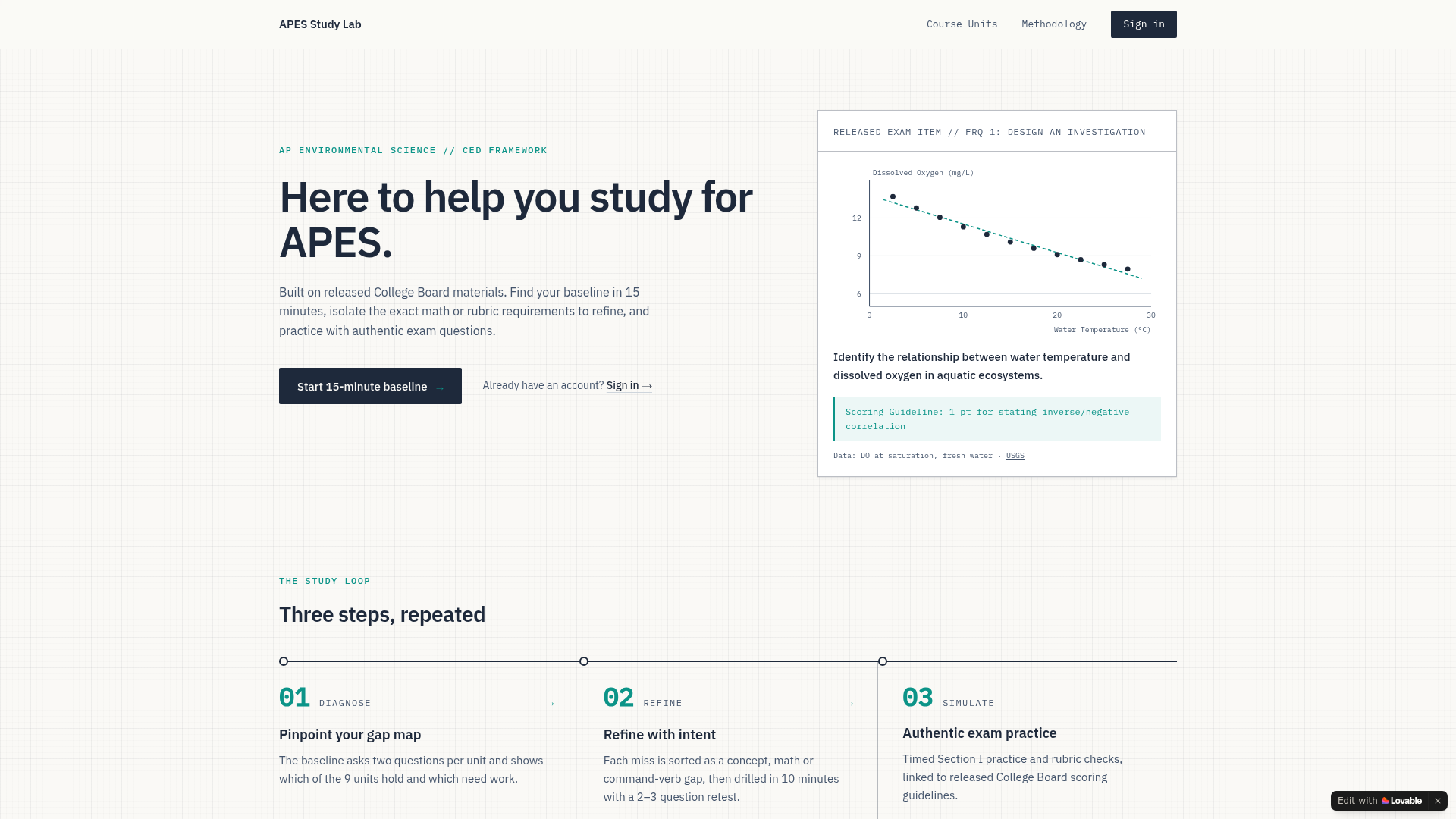
Tap a pin to see what it does.
- 1
Start with a baseline
The starting flow samples all nine course units with two questions per unit. Learners can mark material they have not covered so it stays out of their diagnosis.
- 2
Show the task and the scoring expectation
The landing page pairs a dissolved-oxygen graph with a question and a scoring guideline. The example makes the expected relationship concrete before a learner begins.
- 3
A loop with a clear next move
Diagnose, refine, simulate. A miss leads to a concept, math, or command-verb drill; a retest checks that gap in a new context. Exam misses return to refinement.
Product Decisions & Tradeoffs
What shipped
A nine-unit baseline, gap-focused drills and retests, timed exam practice, and free-response rubric checks
Scope boundary
Focused exam preparation—not a replacement for the course or a guarantee of an AP score
ChoiceThe baseline asks two questions in each of nine units. Not-yet-covered material is excluded from the diagnosis.
Trade-offA short baseline gives a starting point, not a comprehensive measure of mastery in every unit.
ChoiceWrong-answer options map to concept, math, or command-verb gaps. Each gap links to worked steps, focused practice, and a retest.
Trade-offThe classification depends on the answer options. It is a useful practice cue, not proof of a learner's internal reasoning.
ChoiceThe app links course topics and free-response practice to the course framework and released scoring guidelines, alongside timed exam practice.
Trade-offExam-specific practice makes the next task concrete, but does not cover every way to learn environmental science or establish a likely exam score.
The AI Build Story
I use Lovable and Claude as building partners. The working product makes the study logic explicit: a baseline leads to a gap, the gap leads to practice, and a retest checks the next step.
- 01Questions connect to course topics and specific gap types, so the learner gets more direction than a count of wrong answers.
- 02The project includes automated checks for the practice engine and free-response rules. Software checks are not evidence of improved exam outcomes.
- 03The methodology and source links make the study framework inspectable. The loop offers a next action without promising a score.
Try This
Start the baseline and mark topics you have not covered. Pick one gap to refine, read the worked steps, and try the retest before moving on to timed practice.
Next exhibit · 03
Flowline Canvas →