Case Study · K-12 STEM
Deconstructing STEM Discovery Lab
An untimed diagnostic for grades 7–10 that connects physical intuition, arithmetic, and algebra—and turns a short set of observations into a next learning step.
The Insight
A wrong answer leaves an important question open: the science—or the math? This lab looks at the connection between them, so the next conversation with a teacher or tutor can start with evidence rather than a general score.
The Interface (Annotated)
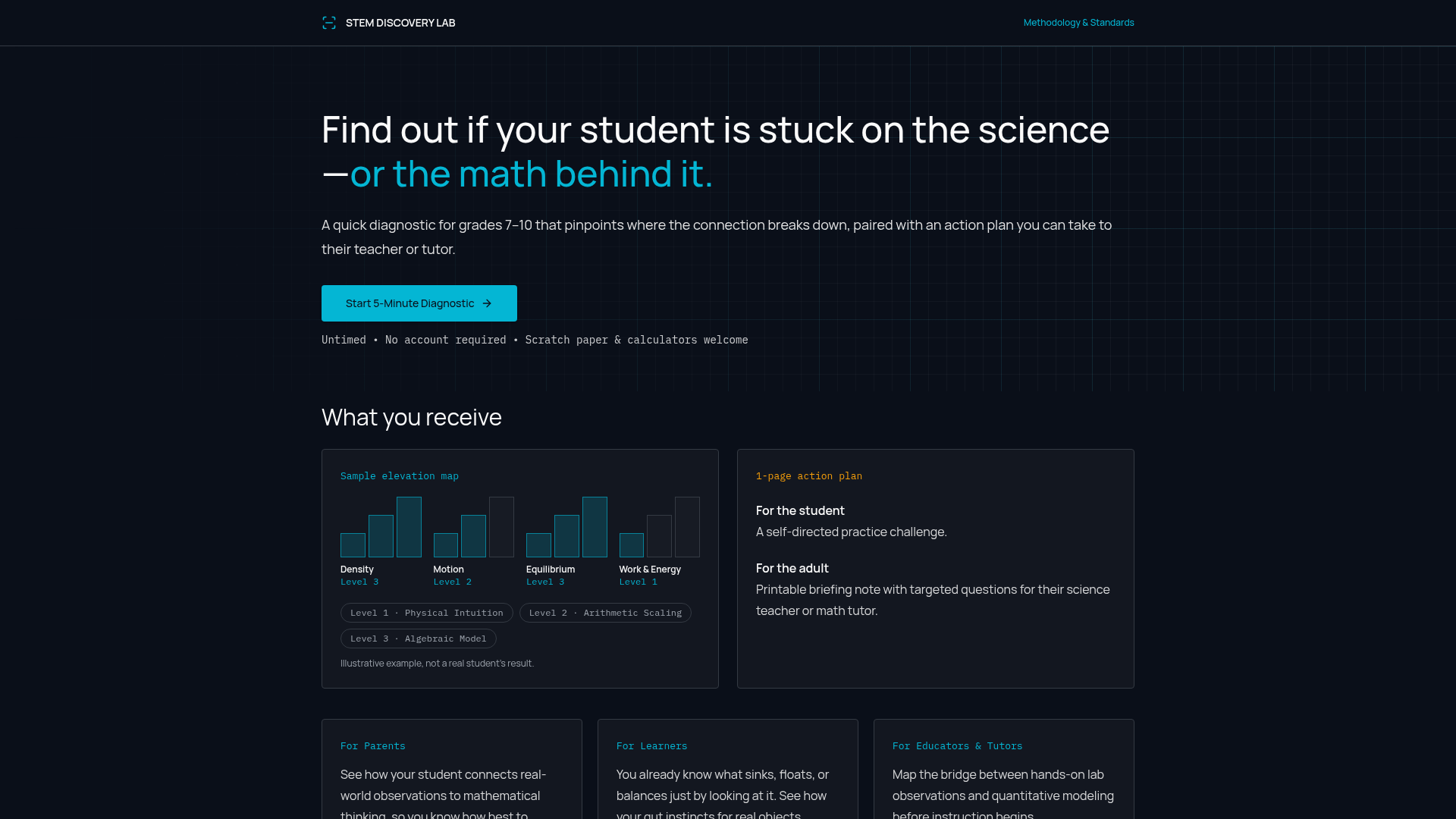
Tap a pin to see what it does.
- 1
A low-pressure starting point
The diagnostic is untimed and needs no account. Scratch paper and calculators are welcome; speed is not part of the evaluation.
- 2
A map, not one overall grade
The sample elevation map previews physical intuition, arithmetic, and algebra across four areas. It is explicitly labeled as an example, not a student's result.
- 3
A next step for learner and adult
The result leads to a practice challenge for the learner and a printable briefing note for a parent, teacher, or tutor.
Product Decisions & Tradeoffs
What shipped
Eight adaptive observations, an elevation map, and a focused practice challenge with an adult briefing note
Scope boundary
A learning snapshot—not a standardized test, a permanent ability label, or a full curriculum assessment
ChoiceEach area begins with arithmetic. A matching answer leads to an algebra question; another answer leads to a physical comparison.
Trade-offTwo observations per area keep the flow short, but only sample a small part of what the learner understands.
ChoiceFixed answer keys determine the next question, feedback, and map. The methodology explains the rules and where a level is inferred rather than directly observed.
Trade-offA selected answer can suggest a snag, but cannot prove how the learner reasoned. There is no AI grading or claim of formal diagnostic validation.
ChoiceThe map selects a focused workout. The adult view adds a printable note and the evidence behind each area.
Trade-offPractice does not change the original diagnostic map. It supports the next conversation rather than measuring long-term progress.
The AI Build Story
I use Lovable and Claude as building partners. In this project, AI-assisted building is separate from evaluating a learner: the diagnostic uses fixed rules, not AI-generated judgments.
- 01The product logic is visible: four areas, two observations each, and a clear rule for which question comes next.
- 02The project includes automated checks for branching and evidence levels. Those checks verify the software rules, not the diagnostic's effectiveness with students.
- 03The result keeps the limits in view: a snapshot of today's responses, followed by a practical next step—not a judgment of permanent ability.
Try This
Try the observations with scratch paper nearby. At the end, compare the map with the evidence behind it, then use the briefing note to start a conversation with a teacher or tutor.
Next exhibit · 02
APES Study Lab →